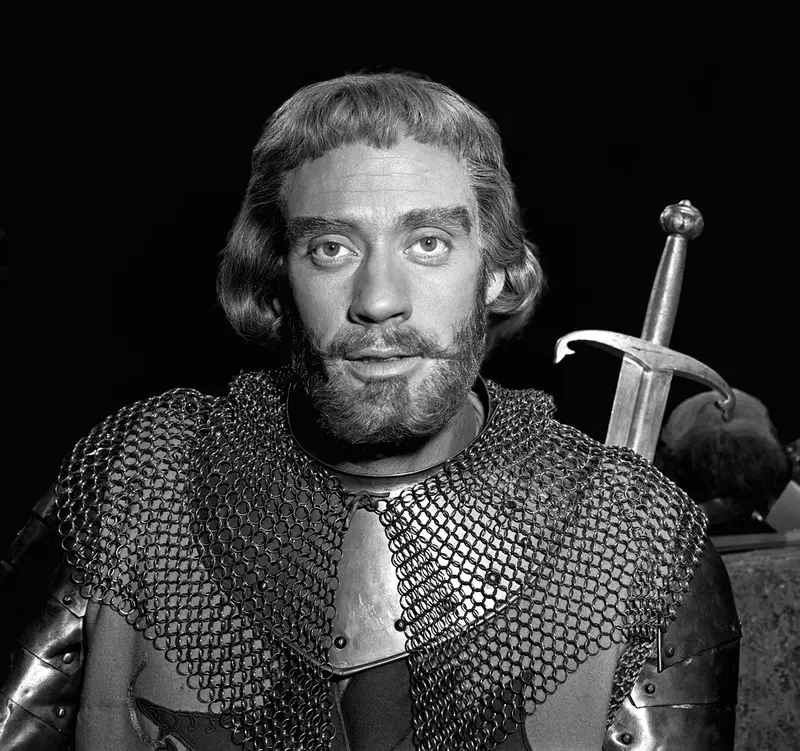
Knights of the Round Table (1953)
- Year
- 1953
- Director
- Richard Thorpe
- Studio
- Metro-Goldwyn-Mayer
- Genre
- Action, Historical
Synopsis
MGM’s first CinemaScope production retells the Arthurian legend from Malory, with Robert Taylor as Sir Lancelot, Ava Gardner as Queen Guinevere and Mel Ferrer as King Arthur. Richard Thorpe directed it in England and Ireland. The record behind it includes trade advertising, a month-long extras’ strike, two Oscar nominations and a $5 million plagiarism suit.
Photo: DoctorMacro.com
MGM sold Knights of the Round Table to exhibitors on one fact. Its advertisement in the Canadian Moving Picture Digest of 6 Feb 1954 opened by calling it the studio’s “FIRST PRODUCTION IN CinemaScope.” Robert Taylor plays Sir Lancelot, Ava Gardner plays Queen Guinevere and Mel Ferrer plays King Arthur. Richard Thorpe directed and Pandro S. Berman produced, and the picture was made in England and Ireland. Talbot Jennings, Jan Lustig and Noel Langley wrote the screenplay from Sir Thomas Malory’s Le Morte d’Arthur.
The story follows Arthur from the sword in the stone, through the founding of his order of knights, to the ruin brought on by Lancelot’s love for Guinevere, which Modred (Stanley Baker) and Morgan Le Fay (Anne Crawford) set out to expose. The script changes the legend in places. It makes Morgan the lover of Modred and makes Percival the brother of Elaine, and it spells the villain’s name the Welsh way, Modred. If you are looking for a copy, only a U.S. print is on DVD at present, and the British prints may have used a different recording of the score.
Cast
- Robert TaylorLancelot
- Ava GardnerGuinevere
- Mel FerrerKing Arthur
- Stanley BakerModred
- Laurence Harvey
- Patricia Owens
- Dana WynterMorgan Le Fay's servant
- Desmond Llewelyn
- Anne CrawfordMorgan Le Fay
- Felix AylmerMerlin
- Niall MacGinnisGreen Knight
- Robert UrquhartGawaine
- Maureen SwansonElaine
- Gabriel WoolfPercival
- Anthony ForwoodGareth
- Howard Marion-CrawfordSimon
- Peter GawthorneBishop
- Mary GermaineBrigid
- Barry MacKayGreen Knight's first squire
Credits
- Director
- Richard Thorpe
- Screenplay
- Noel Langley, Jan Lustig
- Based on a story by
- Thomas Malory
- Producer
- Pandro S. Berman
- Music
- Miklós Rózsa
- Cinematography
- Freddie Young
- Editing
- Frank Clarke
For fans
The studio’s selling, week by week
Most of the record from the year of release is MGM’s own trade advertising, printed in the Canadian Moving Picture Digest. The 6 Feb 1954 advertisement promised the picture “IN COLOR MAGNIFICENCE” and called it “SENSATIONAL IN EVERY ENGAGEMENT.” It put the film at the head of the studio’s January “Jubilee” releases, billed under Taylor, Gardner and Ferrer. Under the words “NEXT FROM M-G-M CINEMASCOPE” the same page named Rose Marie, Brigadoon, Bride for Seven Brothers and The Student Prince. It also listed Mogambo, another Gardner film, among MGM’s current productions, and that issue’s release guide had Knights in its third week at Loew’s in Toronto. By 27 Feb 1954 a second advertisement called the picture “the spectacular CinemaScope sensation” and said it was “packing theatres from Coast to Coast.” That advertisement added Anne Crawford’s name to the three leads, and its guide placed the film at the Palace in Montreal.
On 3 Apr 1954 the Digest reported on Perspecta, a new stereophonic sound system that MGM was adopting. In the item, Mr. Loew called Perspecta “a milestone in the development of the new sound,” and the paper said it would be installed in theatres in France, Australia and Belgium as well as the United States. The item said Betrayed would be the first MGM picture released with Perspecta tracks, and Knights would be the first MGM-Perspecta production shown abroad. It added that MGM’s CinemaScope pictures in domestic release would keep magnetic stereophonic sound. That issue’s guide had the film at the Capitol theatres in Winnipeg and Calgary.
The sources disagree about the color process. The Canadian guides of February 1954 called the film CinemaScope and Technicolor, while the April guides said only “Color.” A later account says the film was apparently shot on Eastmancolor stock, that its credits name no process and that its advertising said only that it was in color. The same account notes that IMDb credits the prints to Technicolor’s laboratory, but Fred E. Basten’s book Glorious Technicolor does not list the film among that company’s prints.
Takings, prizes and a lawsuit
MGM’s records put the film’s earnings at $4,518,000 in the US and Canada and $3,578,000 abroad, for a profit of $1,641,000. Kinematograph Weekly counted it a money maker at the British box office in 1954. The standard account of Mel Ferrer’s career calls it one of his MGM hits, alongside Scaramouche and Lili, though in one place it dates the film 1954. The standard account of Taylor’s career is less kind: of his three English pictures, it says, only Ivanhoe succeeded with critics and at the box office. The film received two Academy Award nominations, one for color art direction and set decoration (Alfred Junge, Hans Peters and John Jarvis) and one for sound recording (A. W. Watkins). The Digest of 27 Feb 1954 printed a tally of that year’s nominations that credited the MGM picture with two, and it reported that the winners would be announced on 25 March. The film also competed for the Grand Prix at Cannes in 1954. In 1956 a claimant sued MGM for $5 million, saying the film came from a script offered to the studio in the 1930s. The judge found that the film and the script both drew on Malory and on Tennyson’s Idylls of the King and had developed the story differently, and he rejected the claim.
The reviewers
Later summaries call the reviews mixed, and Rotten Tomatoes reports that 67% of six critics it surveyed were positive. Bosley Crowther of The New York Times enjoyed the film, likened it to “a spectacular, richly costumed Western film” and credited CinemaScope with giving it life. Steven D. Greydanus of the Decent Films Guide graded it “B” and praised its “colorful pageantry and strongly Christian milieu,” pointing to the royal wedding and the vision of the Grail. Filmink judged the picture “not very good” but named Maureen Swanson’s subplot among its best things.
Making it in Britain
Later accounts place the film between Ivanhoe (1952) and The Adventures of Quentin Durward (1955) in an informal trilogy from Thorpe, Berman and Taylor, all made at MGM’s British studios at Borehamwood with some location work. Ivanhoe and Knights had the same cameraman (Freddie Young), composer (Miklós Rózsa), art director (Alfred Junge) and costume designer (Roger Furse), and Elizabeth Haffenden executed the costumes on Knights. Junge’s Torquilstone Castle set from Ivanhoe was enlarged and redressed as Camelot. In a studio copy of Stonehenge, Taylor pushes over one of the huge stones with ease. Location crews worked near Tintagel Castle in Cornwall with local people as extras, staged the first battle on the Luttrellstown Castle Estate in County Dublin, and filmed the woodland and hawking scenes in Ashridge Forest in Hertfordshire. Most of the interiors were filmed at MGM-British Studios in Borehamwood.
The shoot had its setbacks. George Sanders was cast as Modred but fell ill before filming began, and Stanley Baker, who had just made his mark in The Cruel Sea, replaced him. Two hundred extras from the British extras’ union went on strike for more pay. The stoppage lasted a month and hit other productions before MGM agreed to the union’s terms. Valentine Dyall spoke the opening narration, and Desmond Llewelyn (a herald) and Patricia Owens (Lady Vivien) went uncredited. Rózsa’s contracts required his score to be recorded twice, once in England by the London Symphony Orchestra under Muir Mathieson and once in Hollywood under Rózsa himself.
On paper
Dell published a comic book version, Four Color #540, in March 1954, drawn by Dick Rockwell. Ward, Lock of London and Melbourne issued a text based on the film the same year. Its cast and crew lists are much fuller than the credits on the U.S. prints and appear to come from variant British prints.
Guinevere in Gardner’s career
The usual account of Ava Gardner mentions her Guinevere opposite Taylor’s Lancelot. It also notes that in the 1950s she played a duchess, a baroness and other women of noble birth. Mogambo, made the same year, brought her an Academy Award nomination for Best Actress.
Quick answers
Where was Knights of the Round Table 1953 filmed?
Knights of the Round Table was filmed mostly indoors at MGM-British Studios in Borehamwood, Hertfordshire. Crews also shot near Tintagel Castle in Cornwall with local extras, staged the first battle on the Luttrellstown Castle Estate in County Dublin, and filmed the woodland and hawking scenes in Ashridge Forest.
Is Knights of the Round Table a book?
No, the 1953 film is not a book, but it was adapted from one: Sir Thomas Malory’s Le Morte d’Arthur, which William Caxton first printed in 1485. In 1954 Ward, Lock published a text based on the film, and Dell issued a comic book version.
What is Knights of the Round Table?
Knights of the Round Table is a 1953 MGM adventure directed by Richard Thorpe, with Robert Taylor as Lancelot, Ava Gardner as Guinevere and Mel Ferrer as Arthur. It was the studio’s first film in CinemaScope, and MGM’s trade advertising in February 1954 led with that fact.
Is Knights of the Round Table real?
No, the film is not history. It retells the King Arthur legend from Malory’s Le Morte d’Arthur and changes even that source. It makes Morgan Le Fay the lover of Modred and makes Percival the brother of Elaine, a tie found nowhere in Arthurian literature.