What the Canadian trade paper printed
The Canadian Moving Picture Digest followed the picture through its first Canadian winter. Its issue of January 16, 1954 listed Mogambo at the Nortown in Toronto, billed with Gable and Gardner, and reported that the National Board of Review had placed the MGM film among its selections for the year, in a group with Roman Holiday, Stalag 17, Lili and The Robe. The same issue named Gardner among five actresses who had competed with Hepburn for the New York critics’ best actress title. A column on page three listed Gardner in Mogambo among the year’s “surprise performances of exceptional quality,” in a list that also named Frank Sinatra in From Here to Eternity, and the columnist added that the Academy Awards were next and the decisions would be difficult.
On February 6 the paper carried MGM’s Jubilee advertisement. It put Knights of the Round Table, billed with Robert Taylor, Gardner and Mel Ferrer, at the head of the Jubilee releases, and listed Mogambo, in Technicolor with Gable and Gardner, among the studio’s current productions. The release chart in that issue had Mogambo in its second week at Loew’s in Montreal. By February 20 it was in a second week at the Met in Winnipeg and playing the Orpheum in Vancouver, where Jack Droy’s column reported that the manager, Ivan Ackery, was mounting publicity stunts for it. The same issue reported from Brantford that Bill Burke of the Capitol had run Mogambo on his giant screen at an 85-cent top until a stage appearance by the National Ballet Company broke the engagement on February 8. Burke opened his second CinemaScope feature, How to Marry a Millionaire, on February 11.
The reviews
The New York premiere was at Radio City Music Hall. Bacon’s AP capsule of September 16, 1953 noted that the picture remade Red Dust, one of Gable’s biggest hits of the 1930s, and found the star “virile as ever,” as he had been when much younger. Bosley Crowther’s review in The New York Times on October 2, 1953 argued that the film cared less about adventure in Africa than about the romantic maneuvers of its two popular stars, with color shots of open country slipped in now and then. He called Gable “beautifully commanding” and, saying he meant no insult, “the most important gorilla bagged.” He found Gardner as enticing as any “calculated vampire” could be and judged the romance “hot stuff.” Kelly, in what Crowther called the part of “the stuffy English dame,” was grouped with Sinden and Eric Pohlmann as “all right, too.” His complaint was that more of the stars meant fewer of the animals.
What the company remembered
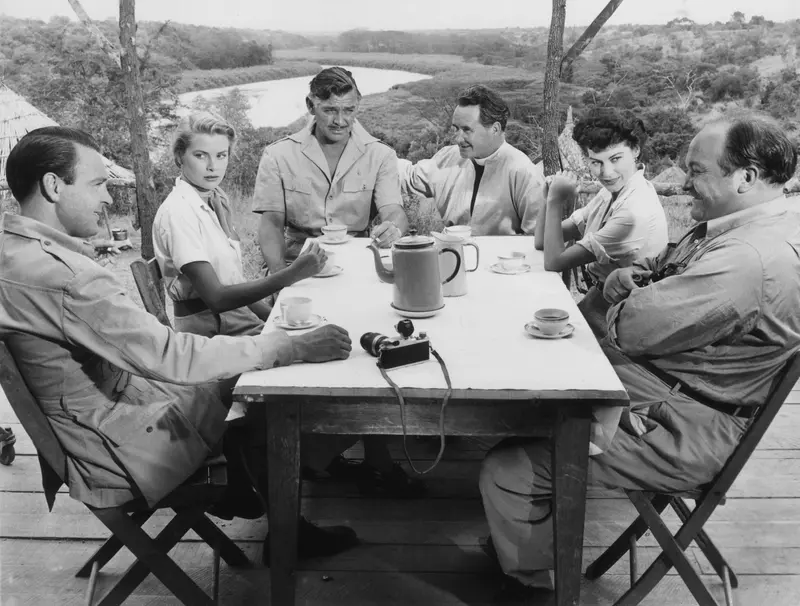
Donald Sinden, then under contract to the Rank Organisation, left the longest account of Ford on location. Ten white hunters were assigned to the unit to protect it and keep it in fresh meat, and Sinden recalled that Ford berated one of them, Marcus, Lord Wallscourt, in front of everyone, treatment Sinden described as abysmal. Weeks later, Sinden said, Ford’s brother-in-law explained it: before emigrating, Ford’s grandfather had been a laborer on the Wallscourt estate in Ireland. On the first morning the make-up men shaved Sinden’s chest on orders. Gable, whose own chest had no hair, insisted that no other actor show a hairy one on film, shirtless crew members included, and took it as a slight on his masculinity. When the unit moved to MGM’s studio in England for the interiors, Sinden found a notice painted at the entrance to the sound stage reading “BE KIND TO DONALD WEEK.” By his account Ford honored it for seven days exactly and pulled the sign down on the eighth.
Gardner’s verdict on her director began with “The meanest man on earth” and ended “Adored him!”; the record does not say when she gave it. Kelly told the columnist Hedda Hopper that Ford, Gable and an expenses-paid trip to Africa were what drew her, and that she would have refused the picture had it been made in Arizona. Ford, for his part, said Kelly showed “breeding, quality, and class.” A break in the schedule let Kelly and Gardner visit Rome.
The production record
The later record of the shoot is largely a list of hazards. Gable landed in Kenya on 1 November 1952 and was given an armed guard because of the Mau Mau Uprising, and filming began on 17 November. A rumor that the Mau Mau meant to assassinate him led Ford to move a location, and two of the crew turned out to be Mau Mau. Rain ruined roads that were poor to begin with, and three crew members, the assistant director John Hancock among them, were killed in road accidents. Frank Allen and his wife guided the safari that made up the location work. The accounts differ on length: the film’s production record calls that safari six weeks, while the record of Kelly’s career gives three months for the filming as a whole. Helen Rose designed the costumes, and the interiors were made at MGM-British Studios in Borehamwood, Hertfordshire.
Kelly was not the first choice for Linda. Shelley Winters and Patricia Neal were both discussed, and Gene Tierney, whom Kelly replaced, dropped out because she would not leave Aly Khan in Paris. Ford had seen Kelly in a screen test for Taxi in the spring of 1952, and MGM flew her to Los Angeles to audition that September. She signed a seven-year contract at $850 a week, on condition that she have every other year free for the theater and could go on living in New York. Gardner had signed in June 1952, the month Ford agreed to direct.
The remake had been years coming. The Los Angeles Times reported in 1946 that MGM was considering it with Marilyn Maxwell; Marie McDonald was reported to have tested for the Jean Harlow part in March 1948; and Maxwell and Gene Kelly were under consideration in May 1949. The studio had already done well with color remakes shot abroad, King Solomon’s Mines (1950) and Quo Vadis (1951) among them. In August 1951 it announced Mogambo as an African location picture for Gable, produced by Zimbalist, who had made King Solomon’s Mines, and he spent six weeks scouting Africa in February 1952. Mahin and Gable had history: in 1943 Gable recruited the screenwriter for the six-man motion picture unit he took to England with the Army Air Forces.
MGM’s books show $4,576,000 earned in the US and Canada and $3,692,000 elsewhere, for a profit of $2,026,000. Gardner was nominated for the Academy Award for Best Actress and Kelly for Best Supporting Actress, the category in which Kelly won the Golden Globe, and the film had a BAFTA nomination for Best Film.
What the articles here add
The shoot overlapped with Gardner’s marriage to Frank Sinatra. In Why Ava Gardner left Frank Sinatra in 1953, just as his comeback began, Sinatra is with her in Kenya in November 1952 when a cable arrives saying Columbia will screen-test him for Maggio in From Here to Eternity, and she charges his plane fare to her MGM account; in March 1954 she was holding her Mogambo nomination on the night he won. How Ava Gardner and Frank Sinatra met reports, following Bean and Uzarowski, that she became pregnant by him in Nairobi and ended the pregnancy in late 1952, after he had gone home and without telling him. How Ava Gardner’s character dies in The Barefoot Contessa records that she lost the Oscar to Hepburn for Roman Holiday. For Gardner’s side of the period, see her memoir Ava (1990) and Lee Server’s biography Ava Gardner (2006).