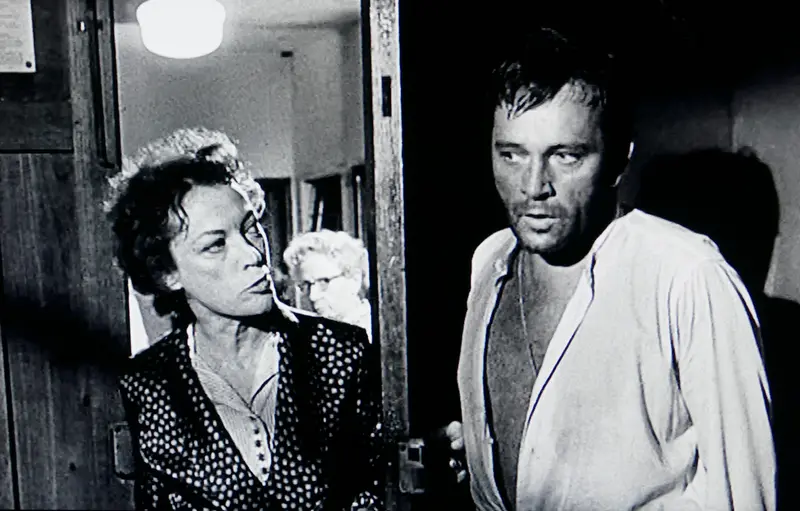
The Night of the Iguana
John Huston 1964
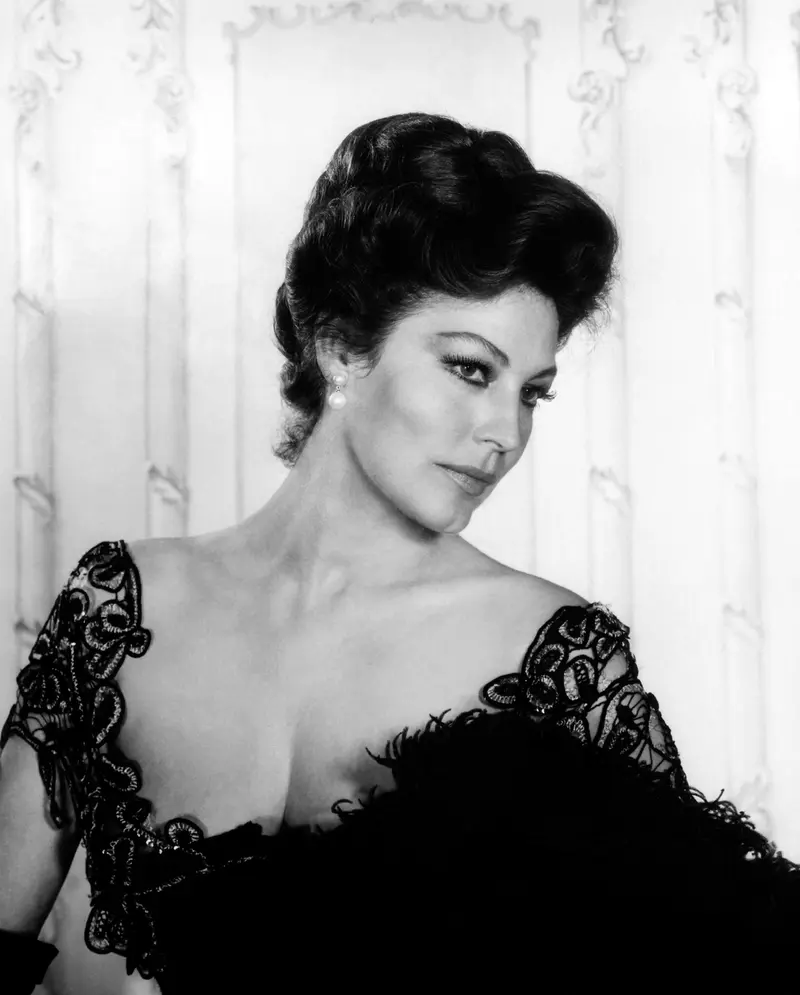
Samuel Bronston’s 1963 epic of the 1900 siege of the foreign legations in Peking during the Boxer Rebellion, shot in Spain. Charlton Heston plays US Marine Major Matt Lewis, Ava Gardner plays the Russian Baroness Natalie Ivanoff, and David Niven plays the British official Sir Arthur Robertson. Production was troubled, reviews were mixed, and Dimitri Tiomkin’s music won two Oscar nominations.
Not listed on Amazon right now. Search Amazon for it.
Photo: DoctorMacro.com
55 Days at Peking is a 1963 historical war epic about the siege of the foreign legations in Peking (now Beijing) during the Boxer Rebellion in the summer of 1900. Charlton Heston plays Major Matt Lewis, a US Marine officer, Ava Gardner plays Baroness Natalie Ivanoff, a Russian aristocrat, and David Niven plays Sir Arthur Robertson, the senior British official in the compound. Samuel Bronston produced it for Allied Artists, which released it on May 29, 1963. Nicholas Ray directed most of it. Gardner is billed between Heston and Niven. In the catalog’s list of her films it falls between On the Beach (1959) and The Night of the Iguana (1964).
Lewis arrives with a fresh detachment of Marines and knows China well. He leads a mixed force of 400 soldiers and Marines from several nations, and he works with Robertson while they wait for a relief column. The Baroness has a scandal behind her. Her brother-in-law, the Russian minister, has cancelled her visa because he wants a valuable necklace back. When she fails to get out of the city, she goes to work in the besieged hospital. Behind all this, the Empress Dowager (Flora Robson) keeps plotting with the Boxers. The cast listing names the Baroness Natalie Ivanoff, but one plot summary calls her Natasha Ivanova. That summary also says Lewis is based on Major John Twiggs Myers.
The trade press listed the film at 150 minutes, in Super Technirama 70 and Technicolor. In its release chart for mid-1963, Motion Picture Exhibitor gave the Legion of Decency rating as A1 and boiled its May 1, 1963 review down to “Segment of history makes impressive entertainment,” adding that it was filmed in Spain. Universal Studios Home Entertainment issued the film on DVD on February 28, 2001, and Anchor Bay Entertainment released a Blu-ray in the UK in April 2014.
On April 1, 1963, Boxoffice reported that Bronston’s company would not road-show the film with reserved seats. Paul Lazarus Jr., Bronston’s executive vice-president, told the trade press that the success of El Cid had led some people to expect the hard-ticket treatment for every Bronston picture. Because this one was aimed at the mass market, he said, it would be released another way. He added that the list of failed roadshows was “much longer and bloodier.” Motion Picture Exhibitor’s report of April 3, 1963 described a release in three waves. First came limited premiere runs from May 29 in 12 cities in the United States and Canada, then a special release in other key cities in July, and finally a wide release in the big markets. Boxoffice listed the 12 cities, put the cost at more than $7,000,000, and quoted Bronston’s domestic sales manager, Harold Roth, as expecting about 1,300 engagements by Labor Day. According to Boxoffice, Allied Artists would handle distribution in the United States, Canada, Japan and the Near East, and the film would have world premieres in London on May 6 and Paris on May 8.
London had its own story. In the same April 3 issue of Motion Picture Exhibitor, Jock MacGregor wrote that Cleopatra had been booked for the Dominion theater in June. Rank Theatres would not pay an advance on it, and Rank chose to open “55 Days at Peking” at the Dominion on May 6 instead. Later accounts say the Rank Organization also distributed the film in Britain, Germany, Italy, Scandinavia and the Far East, and that Columbia handled Australia. Those accounts also report that Earl St. John announced in February 1962 that Rank would put up half the budget, then given as £2.5 million. According to a Variety report of October 1963, Allied Artists had spent $2.9 million on advertising and distribution.
The commercial record depends on which account you read. Accounts of Heston’s career call the film a box office disappointment. Against that, it had a gala premiere at the Beverly Theater in Los Angeles on May 28, 1963 and took $22,000 there in a week. It was the top earner in the United States during the first weekend of June 1963, and by August it was reported to have earned $3.25 million from 400 theaters. Milton Goldstein, Bronston’s foreign sales manager, told Variety that some overseas markets were outpacing El Cid. By January 1964 the domestic gross was $10 million, with rentals estimated at $5 million, and the most commonly cited budget is the same $10 million. Budget figures vary: Ray recalled $6 million, Boxoffice printed more than $7,000,000 before release, and later accounts give $10 million.
Reviews were mixed. Most complaints were about the history and the thin characters, while the acting, action, music and design drew praise. Bosley Crowther of The New York Times called it “rousing, sometimes exciting, action fare.” He also wrote that viewers came away with a “foggy picture” of what really caused the rebellion. Gene Arneel of Variety praised the production design and Jack Hildeyard’s photography, but he wrote that the script “lacks appropriate power.” Philip K. Scheuer of the Los Angeles Times judged the color “as breathtaking as El Cid” and called the characters stereotypes. Time wrote that the picture was “pictorially” magnificent and singled out the watercolors by Dong Kingman that open and close the film. Dorothy Masters of the New York Daily News gave it four stars and wrote that “the film has integrity.” Dimitri Tiomkin received Oscar nominations for the score and, with Paul Francis Webster, for the song “So Little Time.” At Rotten Tomatoes the film currently has a 57% rating from seven reviews.
The idea started in Paris with the screenwriters Philip Yordan and Bernard Gordon. Gordon suggested the Boxer Rebellion and Yordan turned it down. Later, Yordan’s wife found a book in a bookstore with a chapter called “Fifty-five Days at Peking.” The title alone sold Yordan on it. Bronston told the Los Angeles Times that what drew him to the subject was “the unity of peoples” in the face of danger. A rival Boxer project, The Hell Raisers, had been announced at 20th Century Fox by Jerry Wald on September 8, 1959, and Wald signed Niven for it. Wald told The New York Times he was unhappy with Bronston’s plans and filed an infringement complaint with the Motion Picture Association of America. He said he had approached Yordan about a script back in 1956. He sold his version to NBC in April 1962, but he died three months later and it was never made.
Casting changed shape several times. Heston agreed to star in December 1961, on a flight home after El Cid’s premiere in Madrid. He wrote in his journal that he felt uneasy about it. Bronston wanted Gardner for the female lead. Heston did not want to work with her and argued for Jeanne Moreau. Melina Mercouri was offered the part and turned it down because she wanted more rewrites. In March 1962, Bronston told Hedda Hopper he hoped Katharine Hepburn would play the Empress Dowager. Hepburn was announced in June 1962, but by the end of that month she had left and Flora Robson had the part. In the lobby of Rome’s Grand Hotel, Bronston offered Niven $300,000, and Niven said yes without reading the script.
The script was the main problem. Ray recalled in 1977: “No script.” He described handling the gap with two artists in his office, one Chinese and one Spanish. He would describe a scene, they would draw it, and the writers would build dialogue around the drawings. Gordon recalled that Yordan sent their early pages back to “square one.” Arnaud d’Usseau, Julian Halevy, Robert Hamer and Jon Manchip White were all brought in at various points. When Heston read the May 1962 draft, he called the dialogue “primitive” in his journal. About four weeks into filming, Niven threatened to leave unless his part was rewritten. Yordan told Gordon to give him “a Hamlet scene,” and Gordon wrote four or five pages of soliloquy. Niven came back.
Shooting began on July 2, 1962, at Las Matas in Spain, with 3,000 extras, 1,500 of them Chinese. Only about 300 Chinese adults were estimated to be living in Spain, so the rest were brought in from cities including London, Rome, Marseilles and Lisbon. Bronston had already built sets for The Fall of the Roman Empire, and these were torn down to make room for the Forbidden City. During the shoot, Gardner often arrived late, disliked the script and drank heavily. Once she walked off the set, saying an extra had taken her photograph. Ben Barzman came up with the idea of writing her out. According to Heston, Yordan then wrote a death scene in which the Baroness dies of shrapnel wounds. When it came time to film it, Gardner had trouble remembering her lines, and Heston proposed giving her lines to Paul Lukas, who played a physician. Her career as a whole is covered on the Ava Gardner page, and her own account, Ava: My Story, appeared in 1990.
Ray had a heart attack and went into hospital on September 11, 1962. By then the production was six weeks behind schedule. On Heston’s suggestion, Guy Green, who had directed him in Diamond Head, finished the remaining Heston and Gardner scenes. When Green left, the second unit director, Andrew Marton, took over in October. Neither man received screen credit. Marton later said he found the picture shallow, all action and no meaning. He wrote a new opening and ending, and the management, Bronston and Michael Wasynski, turned them down “with a capital N, capital O,” as he put it. John Ford visited the set and told Marton to shoot without hesitating. Heston finished on October 20, and in his journal he vowed never again to begin a picture without “a good finished script.” Filming ended on November 15, 1962. This was Ray’s last film until Lightning Over Water in 1980.
Noel Gerson published a novelization in 1963 under the pen name “Samuel Edwards.” Gold Key issued a comic book adaptation in September 1963, and René Bratonne drew a French newspaper comic version. The film is the first known source of the line beginning “Let China sleep,” a warning about what happens when China wakes, which people often wrongly credit to Napoleon. Gordon’s screenplay contains the line, but Gerson’s books do not. It is also the first known screen appearance of Yuen Siu Tien, who later became a martial arts star. The Japanese director Juzo Itami plays Col. Goro Shiba, credited as “Ichizo Itami.” The next year Gardner played her last major leading role, in The Night of the Iguana. White House projectionist Paul Fischer’s handwritten records suggest it was the last film John F. Kennedy watched in the Family Theater, on November 10, 1963, with Jacqueline Kennedy.
Yes, according to several 1963 reviews, though critics were divided. Dorothy Masters of the New York Daily News gave it four stars and Bosley Crowther called it rousing action fare, while Variety’s Gene Arneel said the script lacked power. Dimitri Tiomkin’s music earned two Oscar nominations.
55 Days at Peking was a 1963 Samuel Bronston epic about the 1900 siege of the foreign legations in Peking during the Boxer Rebellion. Charlton Heston, Ava Gardner and David Niven star. Allied Artists opened it in 12 cities on May 29, 1963, without reserved-seat roadshow engagements.
Yes, in its setting. The Boxer siege of the Peking legations in summer 1900 really happened, and Heston’s Major Matt Lewis is based on Major John Twiggs Myers. The personal stories, such as the Russian Baroness and her necklace, belong to the screenplay.
No, not by the reviewers’ measure. Most of the criticism concerned its historical inaccuracies and thin characters. Bosley Crowther of The New York Times wrote that viewers got a foggy picture of the real causes of the Boxer Rebellion, although critics praised the sets and photography.
We use Google Analytics to see which pages help. Allow it?