55 Days at Peking
Nicholas Ray, Guy Green, Andrew Marton 1963
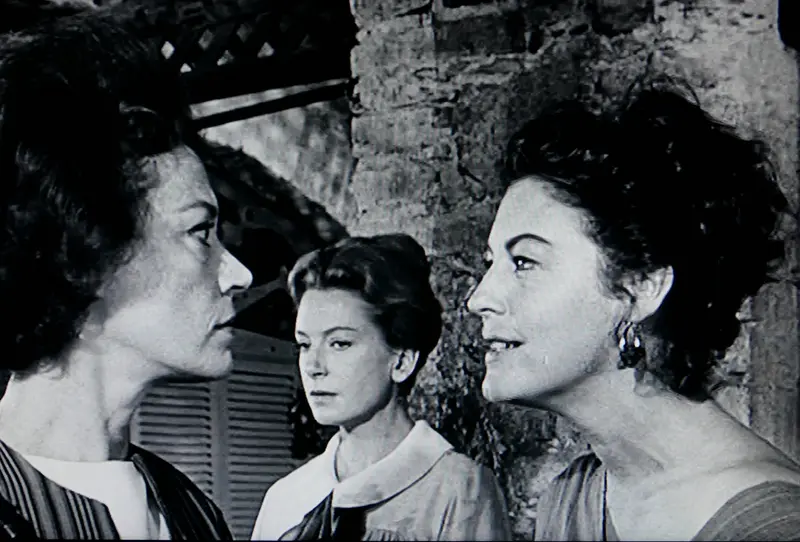
John Huston’s 1964 film of the Tennessee Williams play. Richard Burton plays a defrocked minister guiding a busload of schoolteachers through Mexico. Ava Gardner plays the owner of the remote hotel where he takes them, and Deborah Kerr plays a traveling artist. It was shot on location in Mismaloya, and the Film Daily review of 1964 called it major box-office fare.
Trailer screenshot, Wikimedia Commons (Public domain)
The Night of the Iguana is John Huston’s 1964 film of the Tennessee Williams play. The studio’s pressbook bills it as a John Huston and Ray Stark production presented by Metro-Goldwyn-Mayer and Seven Arts. In the pressbook’s casting account, Richard Burton plays the Rev. T. Lawrence Shannon, a defrocked minister now working as a tour guide, Ava Gardner plays Maxine Faulk, who runs the isolated hotel where he turns up, and Deborah Kerr plays Hannah Jelkes, an artist traveling with her grandfather. Sue Lyon plays Charlotte Goodall, a girl in Shannon’s tour party, and Huston wrote the screenplay with Anthony Veiller.
The pressbook’s synopsis opens with Shannon attacking the congregation of a small Virginia church for its hypocrisy and raging at God while thunder and lightning break overhead. In Mexico he leads a group of schoolteachers in a broken-down bus. Charlotte, whom the pressbook makes 18, has a crush on him, and Judith Fellowes, the teachers’ leader, catches the two of them together and swears she will expose him. Shannon then skips the modern hotel the party was meant to stop at next. The Film Daily review describes the place he takes them as a crumbling jungle hotel steeped in moral chaos. In that review, Kerr’s character and her grandfather (Cyril Delevanti) have been walking across Mexico, she selling her sketches and he reciting his poems.
The film followed 55 Days at Peking, and Gardner’s Wikipedia entry calls it her last major leading role. She was billed below Burton and above Kerr, and her performance drew Best Actress nominations at the Golden Globes and the BAFTAs. Kerr had worked with Huston before, on Heaven Knows, Mr. Allison in 1957. A review from The Film Daily, reprinted in Canadian Film Weekly on 2 Sep 1964, gave the running time as 125 minutes and labeled the picture “MAJOR BOXOFFICE FARE.”
MGM’s 1964 exhibitors’ campaign book tells the casting as a race. Over one weekend, it says, Stark flew to Ireland to see Huston, then to Madrid to sign Gardner as Maxine (Bette Davis’s part on stage), then to Switzerland for Kerr as Hannah (Margaret Leighton’s part), and closed the three-day trip in London by signing Burton as Shannon. Lyon was the one star he could find at home, in Hollywood, and the pressbook calls this her first film since Lolita. The same book reminds exhibitors that Huston won the 1948 Academy Award for directing Treasure of Sierra Madre and had recently drawn a supporting-actor nomination for his acting debut in The Cardinal.
The location story centers on Mismaloya, a tiny fishing village on the Pacific coast. To reach it, the pressbook says, the company took a taxi to a Puerto Vallarta beach and then went eight miles across the bay by dugout canoe or boat. One crew member likened the trip to “landing at Anzio,” and Kerr is quoted laughing, “After getting there, everything else seemed easy.” A replica of an old Mexican hotel stood on a peak about 300 feet above the water. Local workers felled a 37-foot beam of about four tons in the jungle, and because it would not float, engineers lashed it to empty gasoline drums and towed it to the site.
The pressbook reports two months of shooting with no incidents. Huston joked that he had given Burton, Gardner, Kerr, Lyon and Elizabeth Taylor, who had come along, derringers loaded with bullets engraved with one another’s names, and added, “You can’t blame me.” Night work ran to 3:00 a.m., and when Burton was told at 2:30 one morning that his next scene had him hanging upside down in a hammock, he replied, “I’ve never acted upside down before.” After work, the book says, he talked at the bar about 17th-century literature and his schooldays in Wales. A village mother, asked if she knew the stars, pointed at Gardner water-skiing on the bay and said, “There goes Lana Turner!”
The Film Daily critic called the film a “stirring, disturbing tale” and said Huston’s “perceptive direction” guided the cast “with distinction.” The review pictured Gardner’s Maxine as an aging, fiery beauty who keeps two local beachboys as playthings, and it gave the grandfather’s age as 98. Its cast list names James Ward as the bus driver who falls for Lyon’s character. The reviewer praised Gabriel Figueroa’s photography and wrote that Benjamin Frankel’s score “deepens the mood” without intruding. The review also noted that the play had won the New York Drama Critics’ award as the best play of the 1961-62 season.
The papers were divided. Time placed it among “the best movies ever made” from a Williams play. Bosley Crowther of The New York Times argued that the picture never showed what made its people so helpless and hopeless, so their suffering never came to feel meaningful. He called Burton “spectacularly gross” and Lyon’s acting “painfully awkward.”
Later accounts add some casting stories. James Garner said he had been offered Shannon and turned it down as “too Tennessee Williams for me.” Stark had hoped Huston would play the grandfather, and Huston declined so that he could concentrate on directing. These accounts put principal photography at 72 days, while the pressbook says two months. Gardner’s Wikipedia entry records that Huston insisted on black-and-white and later regretted it because the local plants were so brightly colored. When Huston received the Writers Guild’s Laurel Award, Allan Sherman sang a comic song to the tune of “Streets of Laredo,” teasing that the company did things at night “no self-respecting iguana would do.” The film won the Academy Award for costume design. In later years FilmInk called it perhaps “the most delightfully well cast Williams adaptation.”
Gardner’s star page covers the rest of her career. Her own Ava: My Story, published in 1990, and Lee Server’s biography Ava Gardner are good places to start.
Yes, by much of the record, though critics split when it opened in 1964. Time ranked it among the best films made from a Williams play and the Film Daily review called it stirring, while Bosley Crowther of The New York Times said it never made its characters’ suffering meaningful. It won the Academy Award for costume design.
The Night of the Iguana is about a defrocked minister, T. Lawrence Shannon, who guides a busload of schoolteachers through Mexico and strands them at a run-down hotel on a hilltop. MGM’s 1964 pressbook framed it as the story of Shannon and three women who shape his life: the hotel owner Maxine, the artist Hannah and the teenage Charlotte.
In summary, The Night of the Iguana follows Shannon through one long night at Maxine Faulk’s hotel in Mismaloya as he struggles with drink and desire. Charlotte and her chaperone Miss Fellowes threaten his job, and Hannah Jelkes looks after him through a breakdown while her grandfather finishes his last poem.
The Night of the Iguana was filmed in Mismaloya, a small fishing village on Mexico’s Pacific coast, eight miles across the bay from Puerto Vallarta. MGM’s pressbook says the company reached the set by taxi and then by boat, and a replica of an old Mexican hotel was built on a peak about 300 feet above the water.
The Night of the Iguana ends with Shannon and Maxine accepting their attraction and deciding to run the hotel together. Before that, Shannon frees the tethered iguana and Hannah’s grandfather finishes his poem and dies. Hannah turns down any arrangement with Shannon and leaves to make her own way.
We use Google Analytics to see which pages help. Allow it?