Mogambo
John Ford 1953
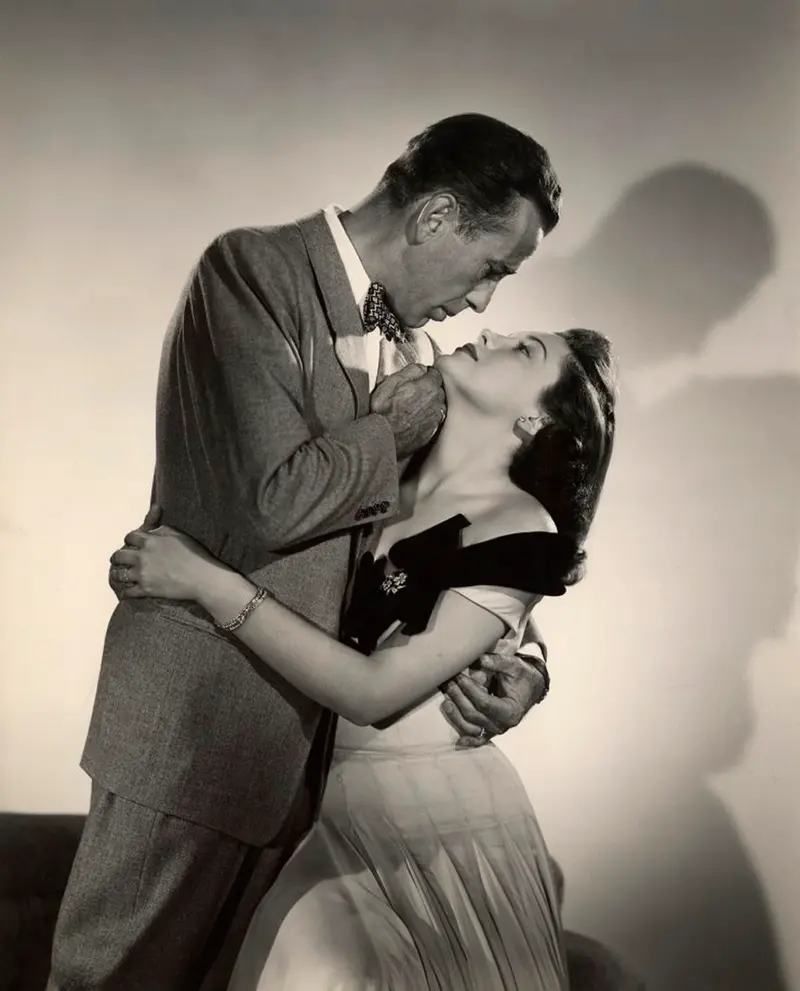
Joseph L. Mankiewicz’s 1954 Technicolor drama follows Maria Vargas (Ava Gardner), a barefoot Madrid nightclub dancer who becomes a film star. Humphrey Bogart plays Harry Dawes, the director who finds her, and Edmond O’Brien plays Oscar Muldoon, the publicist, a part that won him an Oscar. Three narrators tell her story. A trade paper reported it launched United Artists’ “blockbuster” program.
Photo: DoctorMacro.com
The Barefoot Contessa is a 1954 drama in Technicolor that Joseph L. Mankiewicz wrote and directed for his own company, Figaro Inc., and that United Artists released. Ava Gardner plays Maria Vargas, a dancer in a Madrid nightclub who prefers to go barefoot, Humphrey Bogart plays Harry Dawes, a washed-up director and screenwriter, and Edmond O’Brien plays Oscar Muldoon, the publicist, a part that won O’Brien the Academy Award for Best Supporting Actor. Harry, reduced to working for the tycoon Kirk Edwards, brings Maria to America, and her first picture makes her a star. She then leaves Hollywood behind, first for a South American playboy and then for an Italian count played by Rossano Brazzi. Harry tells most of the story, and Oscar and the count each narrate a part of it.
The Canadian Moving Picture Digest of 11 Dec 1954 reported that the film had a gala benefit world premiere at the Capitol Theatre on Broadway. According to the Digest, its takings there beat those of Moulin Rouge and The African Queen, the company’s biggest earners at that house, and United Artists’ sales chiefs predicted it would become one of the greatest hits ever made.
In accounts of Gardner’s career it stands with The Snows of Kilimanjaro and Mogambo among her 1950s pictures. Accounts of Bogart’s career list it, with Sabrina from the same year, among the films that further established him as a leading man. O’Brien’s career had hit a slump in the early 1950s, and Mankiewicz had already used him as Casca in Julius Caesar (1953). For home viewing, Twilight Time put out a high-definition Blu-ray on December 13, 2016, limited to 3000 copies.
The New York Times reported in April 1953 that Mankiewicz was negotiating his way out of a three-picture contract with MGM so that he could form Figaro, Inc. A month later the parties settled on one more MGM film from him. Figaro signed with United Artists for two pictures, and The Barefoot Contessa, which Mankiewicz had begun as a novel, was reported as the first. On 4 Sep 1954 the Canadian Moving Picture Digest covered a demonstration of Perspecta Sound at Loew’s Uptown Theatre and listed the Mankiewicz picture, with Gardner as its star, among the releases that would carry the system. The same item named MGM’s reissue of Gone with the Wind as the first Perspecta release in Canada.
The Digest’s 11 Dec 1954 issue framed the film as the opening of a program that United Artists president Arthur B. Krim had announced a few months before. Krim had called the program’s high-budget pictures “blockbusters,” and the paper wrote that the series started “with a resounding roar.” The second, the $3,000,000 Hecht-Lancaster production Vera Cruz with Gary Cooper and Burt Lancaster, was to follow it into the Capitol. The paper also noted that the film was then in its third week at the Odeon in Toronto. Its listings of 15 Jan 1955 placed it at the Uptown in Calgary, the Garrick in Winnipeg and the Vogue in Vancouver, each time billed with Bogart named ahead of Gardner. That page also carried a United Artists bulletin, issued by board chairman Robert S. Benjamin, putting the company’s world gross for 1954 at $43,100,000.
The dissenters were blunt. Bosley Crowther of The New York Times called it a “grotesque barren film.” In the Saturday Review, Bennett Cerf rated it well above the ordinary picture but wrote that Mankiewicz goes “off the beam” once the story turns to the doomed count. Philip K. Scheuer of the Los Angeles Times called it the director’s “wickedest scalping job to date,” and did not exempt All About Eve from the comparison. He also wrote that the buildup to Gardner’s first entrance would be “the envy of every actress.”
The Chicago Tribune admired the photography and the color and wrote that Gardner had never looked lovelier. The paper still found her stiff for much of the film and handed the top honors to Bogart. Harrison’s Reports thought Gardner “most effective” as the heroine, also praised Bogart and O’Brien, and judged it a “notable production on every count.” Gene Arneel of Variety wrote that it was “original entertainment for grown-up viewers” and that its basic story was strong. Later summaries say the film’s extravagance drew praise from many critics and won Mankiewicz new admirers. In France, François Truffaut defended it for its “freshness, intelligence, and beauty.”
Shooting began at Cinecittà in Rome in January 1954, the period remembered as “Hollywood on the Tiber.” In Ava: My Story, Gardner wrote that she felt “nervous at being in such high-toned company” and that Bogart made things no easier. On her first day, by her account, he turned away from her in the middle of a take and shouted to Mankiewicz to “tell this dame to speak up.” As the shoot went on, Bogart’s coughing fits forced extra takes.
Gardner called her dealings with Mankiewicz “problematical at times.” During a camera test, the cinematographer Jack Cardiff had her lie still at the edge of a sofa while he tried his lenses. Mankiewicz passed by and called her the “sittingest goddamn actress” he had ever directed. Gardner took offense and stopped trusting him. Decades later Mankiewicz told his biographer, Kenneth L. Geist, that he was sorry: he had meant the remark as a joke to put her at ease, and it did the opposite. In March Gardner spent three weeks rehearsing dances and filmed a sequence in the olive groves at Tivoli, near Rome. In April the unit shot exteriors at Sanremo and Portofino, and Bogart did not go to Sanremo.
The sources do not agree on the model for Maria Vargas. Turner Classic Movies names Rita Hayworth, once married to Prince Aly Khan. Lee Server’s biography Ava Gardner names several actresses, among them Hayworth, Linda Darnell and Anne Chevalier. Mankiewicz first wanted an unknown, then considered lesser-known players such as Rossana Podestà and Joan Collins, and settled on Gardner together with the United Artists executives Arthur B. Krim and Robert Benjamin. MGM, which held her contract, loaned her for $200,000 plus 10 percent of the box office. Bogart, by these accounts, took top billing for less than half her fee. Gardner’s lifelong habit of going barefoot, which she and her close friend Alberta Cooney both recalled, is said to have helped persuade her to accept.
Besides O’Brien’s Oscar and his Golden Globe, the film brought Mankiewicz an Academy Award nomination for Best Original Screenplay. Mad mocked it in May 1955 as “The Barefoot Nocountessa,” drawn by Jack Davis. In 1998 Jonathan Rosenbaum of the Chicago Reader named it among the best American films missing from the AFI Top 100. A 2012 guide, Feature Cinema in the 20th Century, dismissed it as “dreadful,” while all 12 critics tallied by Rotten Tomatoes reviewed it favorably. MGM issued it on VHS in 1990 and 1999 and on DVD in 2001. A specialty food store that opened in 1975 took its name from the film. Ina Garten bought it in 1978, and the name went on to her cookbook and then to her Food Network show.
How Ava Gardner’s character dies in The Barefoot Contessa, and how Gardner herself died in 1990 explains that Maria is killed by her jealous husband. It notes that some regard the part as Gardner’s signature role, and that rain at her 1990 funeral in Smithfield put some mourners in mind of a scene from the film. Why Ava Gardner left Frank Sinatra in 1953, just as his comeback began records that she signed for the picture on November 16, 1953, a few weeks after their separation was made public, and that the production held her in Europe for months. That article adds that Frank Sinatra later bought the marble statue of her made for the film and kept it in his garden for more than 20 years. For more on the star, see Ava Gardner.
No. The specialty food store named after the 1954 Mankiewicz film is no longer in operation. It opened in 1975, and Ina Garten bought it in 1978 with the name already in place.
No. The Barefoot Contessa store, a specialty food shop that took its name from the 1954 film, no longer operates. Its name carried over to Ina Garten’s cookbook and from there to her Food Network show.
The sources consulted do not say where the Barefoot Contessa store stood. They record only that it was a specialty food store, opened in 1975 and named after the Ava Gardner film, which Ina Garten bought in 1978.
We use Google Analytics to see which pages help. Allow it?