The Barefoot Contessa
Joseph L. Mankiewicz 1954
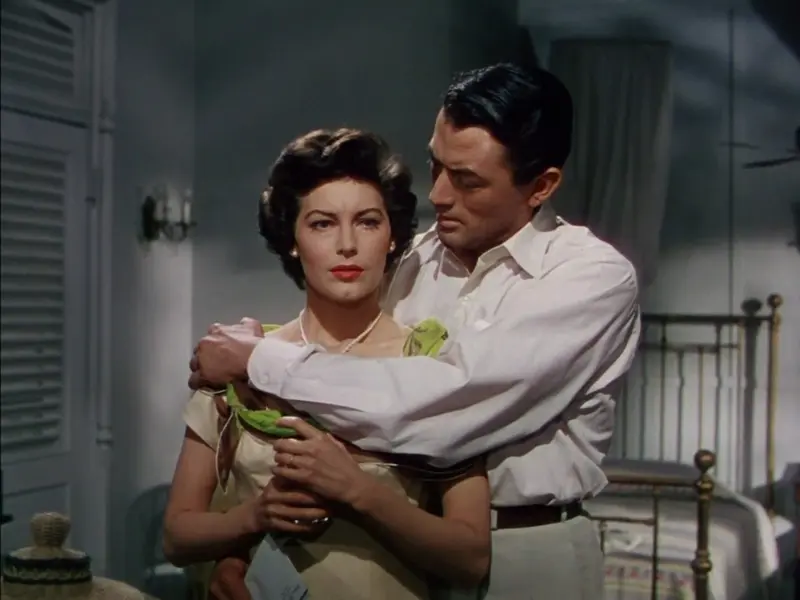
Henry King’s 1952 Technicolor version of Hemingway’s short story. Gregory Peck is Harry Street, a writer lying wounded on an African safari who goes back over his life. Susan Hayward is Helen, who nurses him, and Ava Gardner is Cynthia Green, the lost love the film invented. It was one of the biggest hits of its year, and its photography drew two Oscar nominations.
Not listed on Amazon right now. Search Amazon for it.
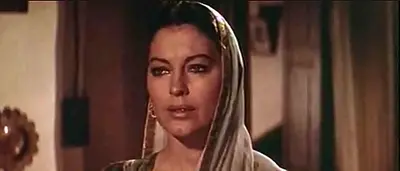
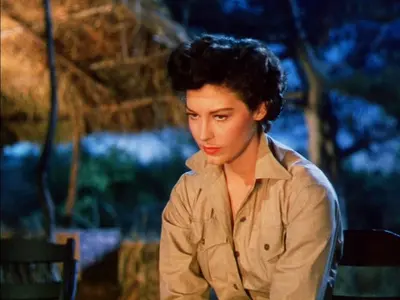
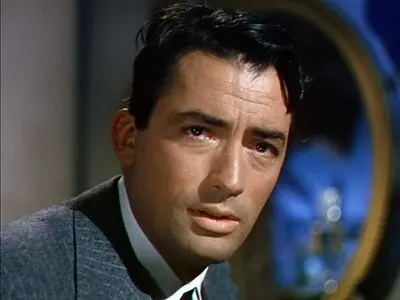
Film frame, Internet Archive (public domain)
The Snows of Kilimanjaro (1952) is a Technicolor picture that Henry King directed for 20th Century Fox. Casey Robinson wrote the screenplay from Ernest Hemingway’s short story, which Esquire first printed in 1936. Gregory Peck plays Harry Street, a writer laid up on safari with an infected wound, Susan Hayward plays Helen, the woman who nurses him, and Ava Gardner plays Cynthia Green, a character the film added to Hemingway’s story. Harry lies outside his tent while vultures and a hyena wait, and in his fever he goes back over Paris, Africa, the Riviera and the Spanish Civil War. The ending is not Hemingway’s.
The trade press tracked the picture’s run closely. On 5 Nov 1952 The Exhibitor reported that the Rivoli on Broadway took $32,000 in the film’s seventh week. By later reckoning it was a critical and commercial success and the third highest-grossing film of 1952, and it drew two Academy Award nominations, both in the color categories, for cinematography and for art direction. The film has since passed into the public domain, and a copy can be watched free at the Internet Archive. Fox put it out on DVD in March 2007, both on its own and inside a five-disc set called “The Ernest Hemingway Film Collection.”
The Exhibitor’s issue of 5 Nov 1952 placed the Rivoli’s $32,000 seventh week in a list of Broadway first-runs, during a weekend the paper described as average business. The newsreel listings in the same issue show that Movietone News (Vol. 35, No. 88) carried a story on the film’s Hollywood premiere, shown only in Los Angeles and San Francisco. The paper’s column of trade notes also joked that the early snow falling on many eastern towns was not, whatever some believed, a tie-up for the picture. In Canada, the Canadian Moving Picture Digest of 29 Nov 1952 listed the film in Technicolor “with Gregory Peck” at the University in Toronto, at Loew’s in Montreal for a second week, at the Orpheum in Vancouver and held over at the Palace in Calgary. The same issue reported a roadshow engagement at Ottawa’s Regent Theatre, where manager Bill Cullum charged 75c for matinees, $1 in the evening and 39c for children, with amusement tax included. The Digest described the film as the screen version of Hemingway’s “new book,” though the story dated from 1936. On 8 Aug 1953 the same paper still listed the film at the Met in Winnipeg and the Capitol in Vancouver.
The film opened in New York on September 17, 1952, and crowds came out to see Gardner. Why Ava Gardner left Frank Sinatra in 1953, just as his comeback began points out that Sinatra cut his last session for Columbia Records on that same day. The article treats the coincidence as one of the clearest moments in the marriage, her career climbing on the day his was sinking.
The accounts of how Hemingway took the film do not agree. According to one report, he disliked the Hollywood happy ending, accepted the money and could not bring himself to see the picture. Yet in a 1954 piece for Look magazine he named the hyena as the best performer in it, a hyena whose voice King supplied from behind the camera. In that same piece he renamed the film The Snows of Zanuck.
Bosley Crowther of The New York Times called the cinematography “magnificent and exciting” and found the color production “full of brilliant detail and surprise.” He praised Peck’s “burning temper and melancholy moods,” and found Gardner “pliant and impulsive” in a part he judged as “soggy and ambiguous” as any in the film. Variety saw a blend of “high adventure, romance and symbolism,” called the color “beautiful” and wrote that “Miss Gardner has never been better.” The same review said the script enlarged the short story considerably while keeping Hemingway’s leaning toward mysticism. Harrison’s Reports called the film “at once absorbing, exciting, and fascinating.” The Monthly Film Bulletin dissented: it heard the Hemingway dialogue as “stilted and a little dated” on screen and said that letting Harry live made the picture “a naive kind of spiritual success story.” Among later critics, Craig Butler of AllMovie wrote that the film has not aged well but praised its locations, its art direction and the romantic chemistry between Gardner and Peck. Bowker’s Directory called it “the popular ‘celebrity film’ of its time.”
Peck’s injury is the best-recorded story of the shoot. On April 8, 1952, he wrenched his knee while carrying Gardner in a scene, and work halted for 10 days while he recovered at his Pacific Palisades home. For the encounter with the hyena, the circus animal trainer Pat Anthony stood in for him. Knef caught influenza at the studio but still sang two Cole Porter songs in the film, and Benny Carter plays in an early scene. The bullfights are not new footage; they were taken from Fox’s Blood and Sand (1941). The unit worked on location in Nairobi, Cairo and the French Riviera, with studio scenes on Stage 14 at Fox. The studio had paid $125,000 for the story in June 1948, and Humphrey Bogart, Richard Conte, Marlon Brando and Dale Robertson were each reported as candidates for Harry before Peck was cast.
Peck’s earlier film with King was David and Bathsheba (1951), his third under King’s direction, in which Hayward played Bathsheba. For Hayward, The Snows of Kilimanjaro was one of three huge successes, together with David and Bathsheba and With a Song in My Heart (1952). The film earned $12.5 million at the box office, and Variety put its domestic rentals at $5.6 million. For Ava Gardner, it belongs with Mogambo and The Barefoot Contessa among the 1950s adventure pictures that made her a leading lady. Peck and Gardner made three films together, the first being The Great Sinner (1949), and they were paired again at the end of the decade in On the Beach. Peck later named her his favorite co-star, and when she died in 1990 he took in her housekeeper and her dog.
Readers who want more on Gardner can start with her own memoir, Ava (1990), or Lee Server’s biography, Ava Gardner.
Yes. Ernest Hemingway’s story first appeared in Esquire in 1936 and was collected in 1938 in The Fifth Column and the First Forty-Nine Stories. Casey Robinson’s script for the 1952 film widens it a great deal and adds Cynthia Green, a character Hemingway never wrote.
Yes, judging by its year: it was a critical and commercial success and the third highest-grossing film of 1952. Harrison’s Reports called it absorbing, exciting and fascinating, but the Monthly Film Bulletin said the changed ending took away its seriousness. Craig Butler of AllMovie later wrote that it has not aged well, though he praised how it looks.
The film ends with Harry Street alive, which is not how Hemingway’s story ends. Helen opens his infected wound by following a first-aid manual, a medical party arrives by plane at dawn as the vultures and hyena leave, and Harry realizes he loves her. The Monthly Film Bulletin objected that letting him survive turned the film into a naive success story.
We use Google Analytics to see which pages help. Allow it?